Earthly paradise

Ever since I saw the film Sicilia! (1998) by Danièle Huillet and Jean-Marie Straub I have wanted to return to Sicily. It is inspired by the book by Elio Vittorini, Conversazione in Sicilia (1941), which I read in French as Conversation en Sicile. I saw the film in France too, at the end of October 1999, in the Studio des Ursulines in Paris (the ticket stub is in the book; sometimes the internal archivist gets it exactly right). It starts with the protagonist sitting in a train going along the coast from Messina to Palermo, it is in black and white, the train is old, the windows are open, and he and his fellow passengers converse in a strange declamatory style. I seem to remember curtains fluttering at the open windows of the train, and views of the sea, as if the railway line ran right beside the shore. The protagonist is returning home after a long absence and there are many things about his home that he has forgotten.

            We were there nearly twenty years ago, for too brief a time, and hardly saw anything,  so obviously I had to go back. Actually what I wanted was to take that train myself, and I did, but of course it is just an ordinary train now, useful for going from Palermo to Bagheria and Cefalù, and the view of the sea is often obscured by concrete. Still it provided a definite frisson, especially when listening to the other passengers’ incomprehensible accents. One of the many ways in which Sicily comes as a shock is that the people don’t seem to be speaking Italian at all; in fact Sicilian is considered a separate language, with elements of the languages of all those who colonised the island, from Greek and Latin to Arabic, French and Spanish. The architecture has all those elements too, from Greek temples to Arab-Norman churches.

            There is a lot to see in Palermo, and there are an awful lot of tourists, large groups being herded around, mostly to the places where there is no admission charge; if you are willing to pay to get in, to a cloister or a baroque chapel, you can be free of them. They also gather, with buskers and loudspeakers, at the beautiful Quattro-Canti crossroads. I remember how years ago we gasped with surprise when we saw it as we drove into the city; it looked like a stage decor. Hurrying away from the music I ducked into a church and saw two fantastic marble angels holding out gilded stoups, one on each side of the door.

            My English guide book had a hectoring tone, with many imperatives – Swoon! Grab! Mooch! Devour! – and was fairly inadequate. Its Italian version (with restful verbs in the infinitive) was better. I went to Monreale in a very crowded bus, saw one half of the Palatine Chapel, as the other half is being restored, and devoured a giant – and extremely sweet – cannolo in a convent garden. I passed the Grand Hotel et Des Palmes several times before reading that Wagner had stayed there, then went in and asked: indeed that is where he wrote Parsifal and his piano is still in the presidential suite. There is a plaque to him at the back of the hotel. Later, in a museum in the town of Castelbuono, I saw an oddly moving artwork by Olaf Nicolai about the writer Raymond Roussel, consisting of photos of the soap he would have used during his last days on earth, spent in the Grand Hotel et Des Palmes. He killed himself there in 1933. There is no plaque for him.

            Abandoning the baroque in favour of Arab-Norman buildings brings you into an emptier and less polished part of the city, originally part of the Royal Park, the Genoardo, from Gennat-al-Ard or ‘Earthly Paradise’, founded by King Roger II (r. 1130-54). This was a hunting ground, farmland and pleasure grounds and some of its buildings still survive, first the amazing Zisa Palace, begun in 1165, a massive building in the Islamic style, with a central hall with mosaics, where water would have trickled down through two basins, extremely thick walls, long corridors and a system of internal air vents for hot days. ‘Nowhere does Norman Sicily speak more persuasively of the Orient; nowhere else on all the island is that specifically Islamic talent for creating quiet havens of shade and coolness in the summer heat so dazzlingly displayed’ (John Julius Norwich, in The Kingdom in the Sun). It has been restored, and I wandered around almost alone, marvelling at its curious architecture, amazed that it had survived at all.

            Then I went down the Corso Calatafimi (also originally an Arabic name), the road to Monreale, with almost empty buses taunting me, unlike the packed one I took to get there myself. There was a 17th century fountain, still functioning, behind bars. Between the more recent buildings were large 17th and 18th century buildings, one now a school, another previously a home for the poor, and then there was the Cuba, another huge rectangular building, built in 1180 by William II in the royal park. In the past this was in a barracks; in On Persephone’s Island Mary Taylor Simeti describes having to get a permit to see it. Now some people who look as if they have just disposed of their predecessors’ bodies sell you a ticket and you enter, again completely alone, a building that was once surrounded by water, and that seems to have been dedicated only to pleasure. It is high and roofless, with muqarnas like the Zisa, and even more than the latter calls up Ozymandias: ‘My name is Ozymandias, King of Kings./ Look on my works, ye Mighty, and despair!’ The Arabic text along the roof  is along the same lines: ‘… Stop and look! See the great room of the greatest of all kings on earth, William II. No castle exists that is worthy of him…’

            Further along the road and up a side street is the friendliest and smallest of all these buildings, the Cubula. It too is behind bars, in a large garden, part orchard full of lemons and medlars, and is, according to the guidebooks, closed. They had both often been wrong, so I walked all the way up to the end, where some workmen were sitting on plastic chairs, about to tidy up the garden. I could go in, they said, so I set off down the path, past the spectacularly decaying 17th century Villa di Napoli and through the jungle of trees and shrubs, all the way down to this tiny pavilion with its little red dome.

There would be just room for two people to sit in it, for a moment’s respite on a hot day, and despite the blocks of flats around it no reading or description could give you more the feeling that you have stumbled into the Earthly Paradise of the Norman kings of Sicily.

            Looking back I took a photo of the side of the Villa, but it was only when looking at the photo later that I found the traces of one more Arab-Norman building, the Cuba Soprana. So I saw that too. Then, walking back towards the city and modern life I passed, on a corner of one of the side streets, a man with a crate and plastic buckets. I stopped to look: he was selling snails, and bunches of wild chicory. Here too I didn’t realise what I had seen until I was home again, wondering if I would ever do anything at all if I hadn’t first read about it or seen it in a film, and started rereading Conversation en Sicile.

In the second part, when the protagonist reaches his mother’s house they talk about the past, and his childhood. He doesn’t remember that they sometimes went hungry; on the last twenty days of the month, his mother says, once their father’s pay had all been spent. And then she says, ‘We ate snails.’ ‘Snails,’ I said. ‘Yes,’ said my mother, ‘and wild chicory (…) That is all the poor had to eat.’

Seething Lane

Some time ago I started following the diary of Samuel Pepys online, getting an email every day with the previous day’s entry. My brother used to get it, and I started doing it too when I inherited his phone after he died. The emails come from the website pepysdiary.com, which started in January 2002, and is now on its third reading of the diary: here is yesterday’s, Saturday, 16th August 1662. ‘Up by 4 a‑clock. And up looking over my work, what they did yesterday; and am pretty well pleased, but I find it will be long before they have done, though the house is cover‑d and I free from the weather.’ The roof had been taken off Pepys’s house a few weeks earlier and of course it rained: ‘I rose and went to my house and find that it is wet as the open street […] removed all my books to the office […] it raining all day long as hard within doors as without.’ (Sat 20 July 1662)

I am not sure exactly why these details should be so fascinating, but the diary is compulsive reading, and not just because of home improvements. It is as if you are in direct contact with someone living in the 17th century. For ten years Pepys described everything, his health, his arguments with his wife, his work at the Navy Office, his money, his involvements with women, gossip from Court and historical events. He was on the ship that brought Charles II from Holland in 1660, and at the Coronation in 1661, ‘although which to my great grief I and most in the Abbey could not see.’ But his most famous description is that of the Great Fire of London in 1666, which raged for several days very near his house and office.

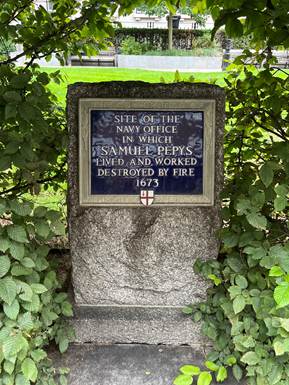
In London recently I went to the City to look for Seething Lane, where he lived and worked. There are few things more enjoyable than following a trail in a strange city, and this part of London was quite strange to me. As a child I was taken to see the Crown Jewels in the Tower of London, but that was all; I didn’t even know that the Monument, familiar only as the name of a tube station, is a commemoration of the Great Fire. Pepys would have known it, perhaps even gone up it, as it was built in 1677. It is closed now, maybe just as well, as it has 311 steps; in the past you got a certificate if you reached the top. Nearby is a plaque marking the spot where the fire started, in a baker’s shop, and some stone blocks with the words of the nursery rhyme ‘London’s burning’ (‘Fire, fire/ Pour on water, pour on water’).

Many churches burned down, the first was St Magnus the Martyr: ‘it began this morning in Pudding Lane, and that it hath burned down St Magnes Church,’ (Diary, 2 September 1666) The churches that survived, many restored by Sir Christopher Wren, are now squashed between huge modern buildings with nicknames like the Cheesegrater and the Walkie-talkie (the hugest and ugliest of them all), their towers elegant amid the glass and metal; it is a miracle that any of them survived.

St Magnus the Martyr

Literally a miracle: in 1920 a commission proposed knocking 19 of them down, and T.S. Eliot wrote that they gave ‘to the business quarter of London a beauty which its hideous banks and commercial houses have not quite defaced.’ St Magnus even appears in ‘The Waste Land’: ‘the walls of Magnus Martyr hold/ Inexplicable splendour of Ionian white and gold,’ but I cannot attest to that as it was, sadly, as firmly closed as the Monument.

The site of the Navy Office in Seething Lane is now a garden,

with a bust of Pepys when young and, if you look carefully, set in the pavement, a few stones with carvings referring to the Diary. One is a page from it, in Pepys’s shorthand, and another, thrillingly, represents his ‘Parmazan cheese’, saved from the flames: ‘And in the evening Sir W. Pen and I did dig another [pit], and put our wine in it; and I my Parmazan cheese, as well as my wine and some other things.’ (Diary, 4 September 1666) Parmazan! No ordinary cheese. He dug it up again on 14 September.

Walking around in this area was like following a map made by ghosts: the buildings have almost all gone but the streets are still there, with their original names as they appear in the Diary. That is all except one, Pepys Street, which comes off Seething Lane, opposite the entrance to the churchyard of St Olave’s, Hart Street, where Pepys worshipped, and where he and his wife are buried. This church, originally built in the 13th century, was badly damaged during the War; in 1666 it was saved from the fire by Pepys and Sir W. Pen, who had houses around it destroyed to make a break to stop the fire. As the author of the ‘Pepys Walk’ writes, ‘You are nearer to Samuel and Elizabeth in this church than anywhere else in London.’ The clerks of the Navy Office asked for their own pew in the church (Diary, 19 August 1660) and eventually one was allotted to them in a new gallery. Now there is a plaque on the outside wall of the church, ‘Entrance to the South Gallery and the Navy Office pew often mentioned in the Diary of Samuel Pepys’.

I have never lived in London, but when I was a child we lived in Richmond and I went to school in Hammersmith. Whenever I go back I get a jolt from the names of the stations on the District Line; these were the ones on the way to school – Gunnersbury, Turnham Green, Stamford Brook, Ravenscourt Park – mysterious places where one never got out. The City was the same: familiar names, like Pudding Lane, but I had never been there. And now there I was, on Eastcheap, Lower Thames Street, Hart Street (of course) and Pudding Lane itself, and it was a little like walking around in Rome and trying to see the past through the present, but here it was muddled up with my own life as well: strangeness and familiarity all at once, and layers of the past, as difficult to read and as easy to miss as those plaques in the paving stones of Seething Lane.

But it is not yet the past: it is still only August 1662 in the Diary, so there are another four years to go before the Great Fire. An awful lot is going to happen in Seething Lane before that Parmazan is made and shipped to London.

Indoors

Not long ago in a hotel in Italy I found myself acting out the scene in A Room with a View where Charlotte and Lucy are disappointed by their rooms in a pension in Florence: “She promised us south rooms with a view close together, instead of which here are north rooms, looking into a courtyard, and a long way apart. Oh, Lucy!” This is the text from the book; as far as I can remember it appears word for word in the film, with Maggie Smith as Charlotte and Helena Bonham Carter as her cousin Lucy. My own hotel room was on a low floor and looked onto a courtyard; peering through a fence one could see a wide expanse of concrete and a few trees. It was dark, and cold, and not what you expect from a hotel advertised as having views of Lake Garda. Tired after a long day, I complained, and was probably, like Charlotte and Lucy, “if the sad truth be owned – a little peevish.” But, as Lucy says, “I wanted so to see the Arno…”

            And then a miracle happened, although mine was less dramatic than in the book, where Mr Emerson, “one of the ill-bred people whom one does meet abroad”, joins in their conversation – “I have a view”- and offers to exchange their rooms for his and his son’s. With me it was a couple who offered to change their room – with view (“if you lie on your left side you can see the lake from the bed”) – for mine, without. Charlotte and Lucy are embarassed by this proposal from an ill-bred man to whom they have not been introduced; as for me I can still hardly believe that anyone wanted my horrid room, and later had to prevent myself from asking them if they hadn’t found it too cold, but at least there was no embarassment involved in accepting. For the rest of the trip I thought of them as Mr and Mrs Emerson, however unlike the fictional character they were, let alone the original one.

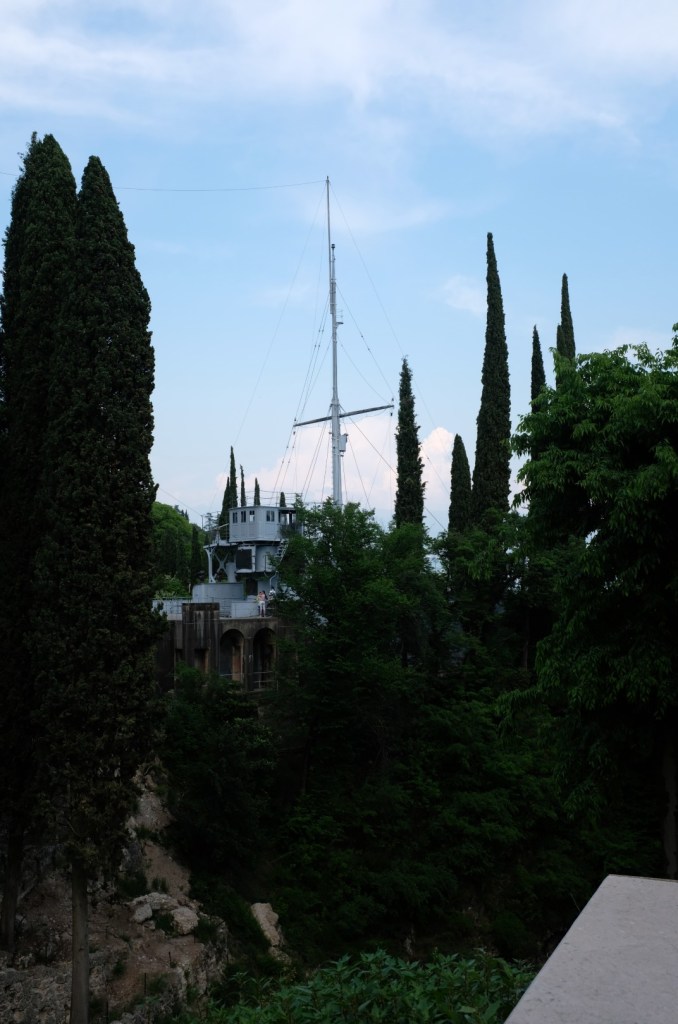
            Later we visited the house of the poet Gabriele d’Annunzio, the Vittoriale degli Italiani in Gardone Riviera, which not only has views of the lake, but also a small aeroplane hanging from the ceiling of the auditorium, and half a battleship in the garden. And a mausoleum and an amphitheatre. One can wander around the

garden and look for the battleship (surprisingly easy to miss), but visitors to the house were only allowed to enter in groups of ten at a time. In her biography of d’Annunzio, The Pike: Gabriele d’Annunzio, Poet, Seducer and Preacher of War, Lucy Hughes-Hallett describes the house as “a bizarre piece of installation art”; it was certainly one of the strangest houses I have ever visited.

            D’Annunzio was a very small man, with bad eyesight; imagining yourself in his shoes you might feel more at home than we galumphing tourists did. The house is exactly as he left it: musty and airless, and you are not allowed to take photos; there are some online but they make it look much brighter and not nearly as strange as it actually is. The first impression is almost as if one were underground, with narrow passages leading into musty rooms, in semi-darkness and so full of objects that you almost panic in an attempt to see it all: there is Dante, and Shakespeare, then Venus, a statue, veiled, of his great love Eleonora Duse, a stuffed turtle, thousands of books, weapons, mysterious texts on the walls, and objects everywhere, things things things, more than you have ever seen together. Hughes-Hallett describes some of the effect: “Everything in the Vittoriale is placed on something else. A rosary is draped over a statuette which stands on a piece of embroidered velvet, which covers a majolica box which is set upon a carved table which stands on an oriental rug. Every window is filled with stained glass and curtained with heavy, rich fabric; every available wall or ceiling space is encrusted with plaques and painted mottoes (…) And in among all the artsy clutter there are modern relics – the steering wheel of a speedboat, a paintbox, a rusty nail.” There is also the kitchen, a completely normal space with no decoration or unnecessary objects; d’Annunzio wasn’t interested in cooking.

            Hughes-Hallett describes how there were two painters “busy transforming d’Annunzio’s rickety old house into a sacred space – part Franciscan, part Buddhist, part nineteenth-century decadent, entirely solipsistic.” And indeed you realise, as you try to shrink yourself to fit and see it all, that it isn’t just that everything is placed on something else, but also that everything refers to something else, to something personal to d’Annunzio; it is all connections and allusions, as if you were actually inside his brain. Some visitors found it so disturbing they didn’t even bother with the battleship and raced for the exit. These shadowy rooms filled with metaphors could not be further from the pure light of day as seen through Lucy’s window in Florence, or even mine from the left side of the bed beside Lake Garda, and it is just as well that one is shepherded briskly through them; d’Annunzio was a very good poet but you would not want to spend too much time in his mind.

Roman history

When our cats were dragged away from a bird or other prey they had caught, they would go, for several days afterwards, straight back to exactly the same place to look for it; in the same way all of those who were present when my brother found a 100 franc note on the pavement on the boulevard St Germain, by place Maubert, always look there in the hope of finding another one. So when in Rome, as I was in February, I go back to the same places, on my first day. Things do not change much in Rome; noticing any small differences reinforces one’s feeling of familiarity with the city, of owning it. Starting with the piazza Navona, where the statues have been cleaned to within an inch of their lives, they positively dazzled in the sun. The Pantheon (still uncleaned), but not inside because now you have to pay, although that doesn’t seem to have deterred the numbers of people waiting outside. The French church, S. Luigi dei Francesi, doesn’t change, or didn’t seem to have at first, but now you cannot get as close to the Caravaggios as you could in the past. There too it used to get very crowded, but on a morning in February I had them all to myself.

          The French bookshop, Libreria Stendhal, is almost next door to the church, and buying a book there is an example of actually catching one’s prey, this year the first volume of Chateaubriand’s Mémoires d’outre-tombe (in a paperback edition, rather than the beautiful Pléïade one that lies unread at home). Chateaubriand was twice ambassador in Rome; there is a curious monument to him, just his head on a pillar, near the Villa Medici.

I wanted to read this because of Proust, who was influenced by him, and because he also wrote about memory. His Mémoires were originally in twelve volumes, the paperback has them in four, but I have not reached his description of memory yet, only a teaser on page 98, a reference to ‘another, more singular, kind of memory, which I may perhaps have occasion to discuss.’      

          There was an exhibition in Trastevere about the oak tree under which the poet Torquato Tasso used to sit on the Janiculum hill, near the church of S. Onofrio, which is one of my favorite places in Rome. I went there often during the time when I had a whole glorious month to myself in the city; there is a bench, there were palm trees, and a view over the city which always makes me think of Leopardi’s view, towards infinity (‘This lonely hill was always dear to me’). There are hardly ever any other people there; once I saw an artist sketching the church, the same view as a print I have of it. There is a plaque on the church, with a quotation by Chateaubriand from beyond the grave, hoping that he may end his days here (‘Si j’ai le bonheur de finir mes jours ici…’), a tribute to Tasso, who died there in 1595 and is buried in the church. I have often tried to visit Tasso’s room, or cell, in the monastery, but never succeeded; the monks don’t answer their phone. But perhaps after this Holy Year, now the statues have been bleached and the bus shelters refurbished, it may at last be possible. Rome would not be a bad place to end one’s days.

          I did see one new thing, in a place I usually avoid, and that was men hoovering up numbers of coins on the edge of the Trevi Fountain, the ones that had fallen short of the water. The fountain too is whiter than white, and was empty, presumably for cleaning. When I go back to Rome there are all the same places, as familiar now as places here in Leiden. Except that in Rome I also have an old friend. This is ancient history, from Paris, more than fifty years ago, when I was wildly in love with him, and he is one of the few people I still know from that time. Foreigners in a strange city can easily lose touch with each other. But when I return to Rome I see him, confirming that I am still here, and so is he, both of us living in places we could not have dreamed of then, and then together, old explorers, we go and visit the ruins of Etruscan temples.

Comfort zones

It is good to leave your comfort zone; that is what someone told me when I said that having vowed never to go on a group trip again, I had signed up for a ten-day holiday along the Atlantic coast of Morocco. I had never wanted to go to Morocco before and am still not sure why I wanted to now. Perhaps it was the words “Atlantic Coast”, which reminded me of holidays in the West of Ireland: empty beaches, huge waves and the exhilarating feeling that the next bit of land was America. I have a collection of pieces of coral in a Wills Handy Cut Flake tobacco tin my grandfather gave me; it came from a so-called coral beach, not real coral I understand now, but I can still feel how painful it was to walk on in bare feet. Belmullet and Achill Island: these were wonderful places, wild and beautiful, now officially part of the “Wild Atlantic Way”, and probably a lot busier than when we were there. Sadly the Atlantic coast of Morocco, at least what I saw of it, was not wild at all, and very difficult to get at. One hotel advertised a beach, which turned out to be down a steep flight of concrete steps and behind a fence, too unattractive even to take a photo.

            The first problem was which travel books to read; everyone recommended Paul Bowles. I didn’t like him when I first read him, so I tried again and found him just as clichéed and pretentious as before. The film of The Sheltering Sky was slightly better than the book, thanks to the photography, and scenes of Tangier, where my trip was to begin. I read a book by someone doing up a house in Casablanca who was having trouble finding the right tiles, and I looked for Mohamed Choukri’s classic book Le pain nu (1980), translated into French by Tahar Ben Jelloun, then decided it would be good to buy a copy in the country itself. But just as I had been mistaken about the wild Atlantic coast, so it seemed that I was also deluded about travel literature about Morocco. Tangier sounded so romantic – the Beats, the expatriates – but their books were not inspiring. William Burroughs lived in Tangier for a time and wrote Naked Lunch there; I am never going to read that again. I didn’t know it at the time but the café in Tangier where we had lunch was where Burroughs used to buy drugs and find male prostitutes. This was not mentioned by the guide, but he did take us to a café, once patronised by rock groups, where a few kif smokers from central casting sat around in semi-darkness, considerately leaving the verandah for the tourists.

            I finally found a copy of Le pain nu, at a kiosk in Rabat; it is a pirated one, copied from the Seuil edition, with the bottom edges of the pages cut off. It is a powerful story, partly set in Tangier, which starts with the killing of the narrator’s brother by their father, but you wouldn’t call it travel literature. The real surprise didn’t come until I was home again, complaining about my Moroccan reading, and somebody mentioned Elias Canetti on Marrakesh. Long ago I read that Canetti had an affair with Iris Murdoch, during which he treated her very badly. This must have been in one of John Bayley’s books about her, and it is obviously not a good reason not to read him, or even actively to avoid him, but the result was that I had never read anything by him.

            Canetti’s book is a collection of short pieces, The Voices of Marrakesh: A Record of a Visit (1967). The English edition dates from 1978 and is now available as a Penguin Modern Classic. It makes up for all those other books on Morocco, all the non-existing ones that nobody was inspired to write; it is one of the best books of travel impressions that I have ever read. I spent two and a half days in Marrakesh, mostly trudging around behind a group of strangers, and how I envy Canetti, who was there for several weeks and was able to wander around alone. I saw some of the things and places he describes, and when I read him it is as if my eyes were closed when I was there, as if I had only been told that I saw them.

            He writes about camels (very upsetting), beggars, the souk, bargaining, everything, in a way that makes you see it differently. I am glad I read this book after my trip; otherwise I might have seen it all through Canetti’s eyes. As it is I know I didn’t see enough, but there is one chapter, “The Silent House and the Empty Rooftops”, which describes something that I did see as he did, very briefly. In a museum in Marrakesh I went up to the roof terrace; there was another staircase so I went up that too, and found myself alone, looking over the flat roofs of the city, in complete silence. I was no longer part of a group, was far from the unnerving bustle and people selling things in the alleys, looking out over a flat landscape in the sky. As Canetti writes, “You feel you could walk all over the city up there.” The Atlas Mountains were just visible in the distance, there were the tops of palm trees, the odd tower, the terrace was full of pink trumpet vine; it was all at eye level, it was the perfect view. So that was why I wanted to go to Morocco.

Eden Garden

If a journey has been put off too often or for too long it loses its lustre; when you finally do accomplish it you wonder why you wanted it in the first place. This is what happened to me with Venice. Last year I booked a trip for February of this year and had to cancel it twice, and it was only after several months that I was finally able to go, just now, in October. I had a burning desire to go there, I do remember that, also to make up for the fact that on two previous visits I had never managed to see all I wanted. But by October the burning desire had faded, reduced to a rude limerick about Titian (rhymes with coition) that Rudy once told me, playing on a permanent loop in my brain.

     It wasn’t that I didn’t enjoy being there, it was of course quite wonderful and I saw some fantastic paintings. Not much Titian though, or not enough, and many of the Carpaccios were locked away being restored, or replaced by large colour photocopies. But it was an odd experience, wandering around and wondering what I was doing there. I even began to wonder, gazing unimpressed at the palaces on the Grand Canal, if I hadn’t somehow inherited Rudy’s dislike of Gothic architecture, which was the reason why I hadn’t seen enough of the place when we were there together. A dead spouse’s opinions can live on, especially such strong ones.

     In Venice I bought a copy of Venise à double tour (2019), by Jean-Pierre Kauffmann, a journalist, one of the French hostages in Lebanon in the 1980s, who spent several months in Venice trying to visit all the locked churches. It is an almost impossible quest but undeniably a good reason to be there, and his descriptions are marvellous; I went to the Giudecca, where he stayed, because of what he wrote about the view and the particular sound of the vaporetto as it arrived in front of his house. One of the many places he couldn’t visit was actually on the Giudecca, a garden made by an English couple, Frederic and Caroline Eden, between 1884 and 1900. Henry James visited it, so did Proust, Browning, D’Annunzio and Cocteau. It has been closed since the death in 2000 of its last owner, the painter Friedensreich Hundertwasser, who let it run wild. A real secret garden! By an amazing piece of luck Kauffmann was able to visit it, but alas he is no gardener, so his description falls rather short (“paysage idéal, rêve d’harmonie entre l’homme et la nature, fermé aux regards…”). It is the same as his locked churches; sometimes it is enough to know that such a place exists.

     On my last full day I followed a walk from a guidebook, which took me to the English church, where I hoped to see the tombstone of Joseph Smith (1682-1770), art collector and for many years British Consul in Venice, who was Canaletto’s patron (which is why there are hardly any Canalettos in Venice, Smith bought them all and later sold them to George III). It was Sunday morning and there was a service, the same service I sat through every Sunday of my youth. Friendly people pointed me to a seat and handed me a hymn book; Smith’s tombstone loomed on the other side of the church, escape was impossible. So I stayed, and at the sound of the familiar words, still not sure what I was doing there, found I had tears in my eyes. For a moment I could see myself going to church every Sunday again, being part of a congregation, believing, consoled.

     At the end of the service prosecco was served in paper cups (an excellent innovation), and I was able to sidle up to the tombstones. And there were the Edens: “They wrought with God and nature in the making of the Giardino Eden in this the well-loved home of their adoption. May they rest for ever beside the living waters in the eternal refreshment of the love of God and of their friends.”

Old ghosts

Searching for traces of writers and artists in Nice was disappointing; a book about the city had several addresses – Nabokov, Matisse, Alexander Herzen – all of which turned out either to be anonymous modern buildings or no buildings at all, and certainly without any plaque recording the great man’s presence. I did find a place where Nietzsche ‘first stayed in Nice’, and a hotel in the rue Gounod where both Chekhov and Lenin had been, but nothing more. Fictional characters were better remembered; over the door of a café where I had coffee was a plaque identifying the square where the hero and heroine of La douceur de la vie by Jules Romains fell in love. This novel, published in 1939, the 18th volume of his series Les hommes de bonne volonté, is currently out of print, and I felt guilty that the copy of it that I borrowed from the university library was lying unread at home.

            Patrick Modiano is not out of print, and it was easy to find Dimanches d’août (1968), which is set mostly in Nice. It is a story which goes back and forth in time, with a narrator, about whom we are told that his name is not Henri, and Sylvia, with whom he elopes to Nice. She has a valuable diamond necklace, and you can tell this will end badly when the narrator picks her up wearing it at the station, and hopes no-one on the train has noticed it.

            Instead of real writers on the streets, the story sends these fictional characters down the real streets near where I was staying in Nice; no need to search for them, they were all around. The narrator takes the rue Gounod to the station, then returns to the Jardin Alsace-Lorraine, exactly what I did myself. Alsace-Lorraine is a large square with beautiful trees, where the couple, who are running away, often sit. Later on the narrator sees lights in a window on the corner of the square and remembers Mme Efflatoun Bey, who lived there: ‘c’était un fantôme aimable, parmi les milliers d’autres fantômes qui peuplent Nice (…) Les fantômes ne meurent pas.’ Even Modiano’s invisible characters have memorable names; I too thought of Mme Efflatoun Bey every time I passed the square.

            These streets – the rue de France, rue de la Buffa, boulevard Gambetta – which the narrator walks along, are residential, not far from the Promenade des Anglais but quiet, with a few hotels and some very ornate buildings. Wandering along them, especially in the evening, it was easy to imagine ghosts turning a corner just ahead. One evening, in the book, the couple sit at a terrace on the Promenade, like all those people through the years who have sat at that terrace: ‘réfugiés en zone libre, exilés, Anglais, Russes, gigolos, croupiers corses du Palais de la Méditerranée.’

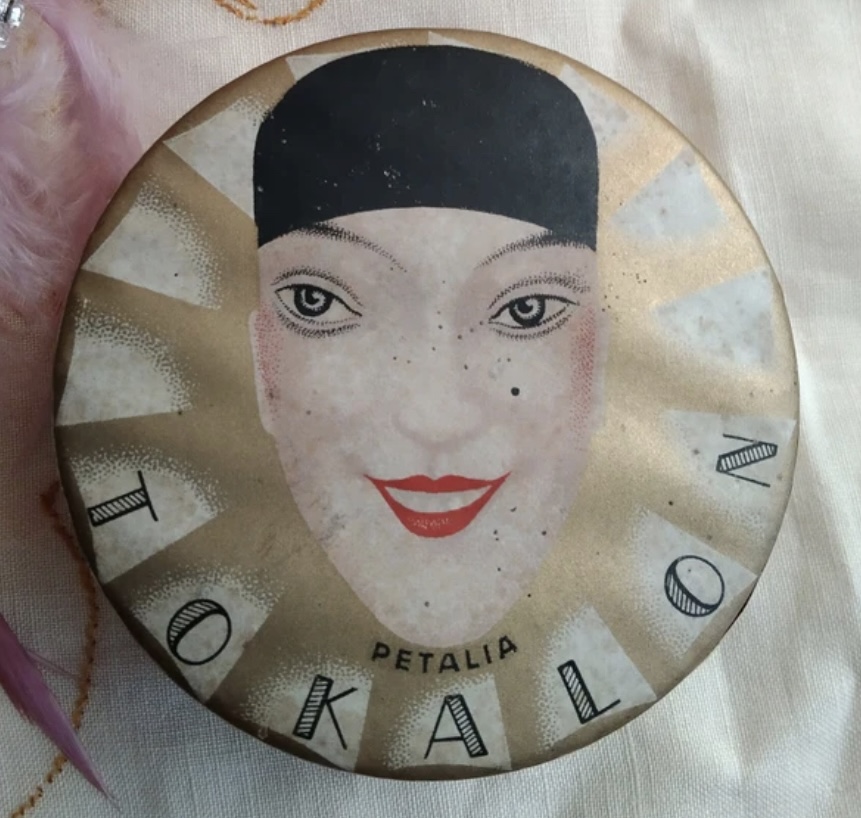
            There the narrator and Sylvia fall into conversation with Mr and Mrs Virgil Neal, who speak French with imperceptible foreign accents; he is American, she is English, they live in a villa called Château Azur and their car has a Corps diplomatique plaque on the back. An elusive pair, whose accents sometimes slip so they sound French, who seem interested in buying the diamond necklace. Later on they drive off, with Sylvia and the necklace, and vanish. The narrator searches for them in vain: their villa now belongs to the American Embassy where the Consul tells him that Mr and Mrs E. Virgil Neal lived there in the 1930s, when they had a company making a beauty product called Tokalon. It all sounds very convincing, and it is because, like the writers on the streets, it turns out that the Neals really existed.

            I discovered this after I got home, in Mary Blume’s Côte d’Azur: Inventing the French Riviera (1992). Tokalon was a ‘moderately priced cream-based face powder […] in pretty round compacts with a Pierrot face painted on the lid,’ she writes, and Neal was not a member of the smart set, but a ‘gladsome parvenu’.

He has not been forgotten; the street where his Château d’Azur still stands is now called Avenue Virgile-Neal. Mr and Mrs Virgil Neal, driving off in their borrowed diplomat’s car fifty years after they had supposedly left the city, are revenants. Sylvia has been abducted – the moment when they drive off with her is very upsetting – and the narrator remains behind.

            Nice does seem a place where strange things could happen, hidden away behind the glorious seafront and the joggers on the Promenade des Anglais, in the streets where the events of Dimanches d’août take place. But it is France, the country I left thirty-five years ago, and when I got to Nice I felt like an exile finally returning home. It was a place to recover, a place of refuge. And I didn’t see a single ghost.

The ideal city

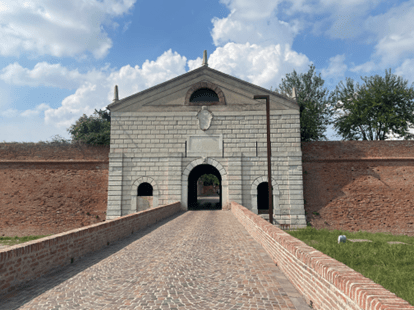
It was like a dream, crossing a bridge, going through an archway and finding myself in a completely empty Renaissance town. There were houses, and streets, and the streets had names, but there were no people. There were hardly any trees either, and it was very hot. The archway through which I had entered was called the Imperial Gate; at the opposite end of the town was the Victory Gate, and between the two were zigzagging walls, with wedge-shaped bastions on the six corners. This was a fortified town, one man’s dream, the town of Sabbioneta, built as the ideal Renaissance city by Vespasiano Gonzaga Colonna (1531-1591), a member of a cadet branch of the Gonzagas of Mantua.

            The road from Mantua goes past Sabbioneta, so all you see of it from the outside are brick walls and the Imperial Gate; it looks extremely private. Were there signs saying “Welcome to Sabbioneta, Unesco World Heritage site”? I didn’t see them. Disoriented, just glimpsing a Poste Italiane van whisking off like the White Rabbit in Alice in Wonderland, I got myself to the deserted main street, the Via Vespasiano Gonzaga, and found the first amazing building in this tiny town, the 96 metre long Gallery. It was empty, like everywhere else, and the view of it from ground level gives no idea of the glory above, on its first floor. It stops at the road, seeming to go nowhere, but the other end leads to the Garden Palace. Even in this small town the duke had not only a ducal palace, on the main square, but also a garden palace, with smaller rooms, ornately frescoed, from one of which you step, quite unexpectedly, into the first floor of the gallery. This is all painted wood, with trompe-l’oeil paintings at each end, with columns and garlands and cherubs and views of imaginary cityscapes. The city end stops short, with a door leading into thin air. The gallery is empty now, having originally housed the duke’s collection of antiques. Here there was another visitor, a smartly dressed old man who said, as we met in the middle of this deserted splendour, “Incredible, in such a small place.” He would have taken his hat off, had he been wearing one.

            I saw him again, from time to time, turning a corner; it would not be easy to avoid people in Sabbioneta. The empty streets, classical buildings and the heat made it feel like a painting by de Chirico, and there were surrealist touches too, the room in the ducal palace with a frieze of elephants, and the wooden equestrian statues of Gonzagas, one of Vespasiano himself, dating from 1589. Four lifesize riders in armour, on wooden horses, quite startling at first sight. Two people were sitting outside a café as I passed, but by the time I came back they had vanished and the café closed.

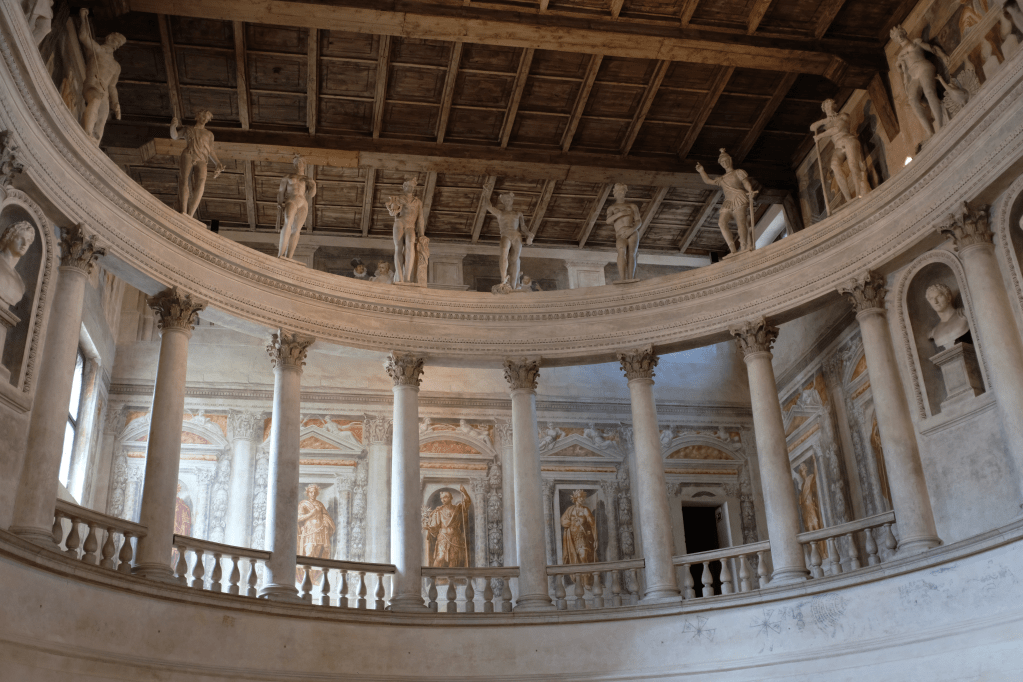
            The most wonderful sight in Sabbioneta is the theatre, built between 1588 and 1590 by Vincenzo Scamozzi, the first Italian theatre built as such rather than an existing building. Here too you step straight from the street into the Renaissance; there is a semi-circle of columns with gods from Olympus above them, and painted musicians and spectators on the walls. Much has changed, the roof, the stage, but these remain, they have been standing there for nearly 450 years.

            From inside the walls of Sabbioneta you cannot see out and the streets are straight and narrow and empty, just like Renaissance paintings of ideal cities. Squinting down one very long arcade I thought I saw a few people sitting outside on plastic chairs, but otherwise the town seems to be as Vespasiano left it, in decline since his death in 1591. I got there from Mantua on a bus full of schoolchildren, all on their phones and unnaturally quiet, only one of whom got off at Sabbioneta. On the way back there was a man waiting at the bus stop, very friendly and talkative, full of complaints about the buses and recommendations about food: I was back in the real world. Then he said he was a pilgrim, and had just walked from Assisi. So maybe not.

Orbits

I’ve felt a bit gloomy, the last few times I was in Paris, walking around on my own. Everything so familiar, un seul être vous manque, and all that. So I was avoiding the place, which is easily done, although not without the occasional pang when I saw that friends had been there, seen exhibitions and taken pictures of corners of streets that I know so well. There is also the consolation that things have changed, that it is no longer the Paris I grew up in – if you can count spending the first twenty years of my adult life as growing up, which I do – so that in fact it no longer exists.

All this has just changed, after a brief visit to celebrate a friend’s seventieth birthday. We met in our first year of studying Chinese in the glorious surroundings of the Porte Dauphine, at the end of the avenue Foch, in the old NATO building. Other departments of universities were also there, like Sciences Eco, whose students didn’t really fit with the ragged band of Maoists doing Chinese, and it felt very far away from everything. Many students were living at home, going to the university as if to an office, so there was no campus life. I had a room in someone’s house myself at the time, which was fine but not exactly cosy, and making friends with Hélène, who was living with her parents in Vincennes, was an amazing piece of luck, not only for herself but also because her parents were extremely hospitable. They often invited me to dinner, so there I would be, with my imperfect French, between her parents and three brothers, pitchforked into tremendous discussions – it was explained that there had been so many arguments that all the reference books, atlases, dictionaries, etc, had been moved into the dining room in order to settle them more easily – punctuated by gales of laughter. My family at home just ate, I suppose we must have laughed as well, but not like that. I was like Charles Ryder in Brideshead Revisited, or indeed Evelyn Waugh himself, falling in love with a whole family; this was a better family, and I wanted to be part of it. Knowing that I could not be was probably part of its attraction. 

Hélène and I reminisced about all the laughter; we always did it when we saw each other. I remember having an actual pain from laughing when we tried – why? after an argument, probably – to represent the orbits of the earth and the moon around the sun on the wide pavement of the Champs-Elysées. I have never been there since without thinking of that.

We had a birthday lunch with other old friends, and in the evening took the metro to the Seine, to see all the changes: no cars along the river, the Samaritaine all shiny and open at last, and Notre-Dame in its scaffolding. Everything was as if made new, and bright, which is not usually the case when you return somewhere. Paris renews itself, all the time. Hélène and I are sensible old women now, one divorced, one a widow, who hadn’t seen each other properly for several years, so we no longer pretend to be planets, but we can still laugh, and feel almost as we did fifty years ago. Her parents are dead now; the house in Vincennes is sold, the metal gate of the courtyard, where her father’s DS used to stand, is gone, and the dining room with the dictionaries too. But part of our youth is still there, and Paris too.

Inland Sea

The Inland Sea of Japan doesn’t sound like a place that one can actually visit: too distant, perhaps even not quite real. I have long known its name thanks to Donald Richie’s marvellous book, The Inland Sea (1971), and know people who have been there, but never thought I would see it myself. It is a romantic idea, an Inland Sea, and Japan has the only one, as far as I know. It lies between three of the four large islands that make up the country, and contains many small islands of its own. Richie travelled the whole length of it, in search as much of himself as the Sea, and wrote about it so beautifully that no-one else ever need try.

            I am still quite surprised to have found myself there, last month, not only on its shores but on three of the small islands, two of which, Miyajima and Naoshima, are described by Richie. They have changed since he was there, especially Naoshima, then “a small, beautiful, somehow sad little island,” now an “art island” with a good hotel and a museum designed by Andō Tadao, and a number of other art sites. Knowing beforehand that these buildings were there, and that they were made of unadorned concrete (except the part of the hotel I stayed in, which was made of friendly wood), didn’t help with finding one’s way around them, as they sometimes seemed intended more to be looked at than to be in. At one museum I rounded a corner to find a group of people standing in semi-darkness in front of a closed door with a red light beside it, waiting to be allowed in. Two Japanese women arrived and sorted things out immediately: the light was the fire alarm and the door didn’t open, we had simply taken the wrong turning. One man told me how embarassed he was as this was his second time there and he had got lost the first time too.

            Reaching an actual door, with more people waiting outside, I think for Monet’s Waterlilies, and hearing that only eight persons, shoeless, were allowed in at a time, I gave up, retrieved my lovely transparent Japanese umbrella (exactly like the ones held over politicians in photos in the Japan Times) and blundered back out into the rain. It rained heavily on Naoshima, but the next day, when I set off for the next island, Teshima, the weather was glorious.

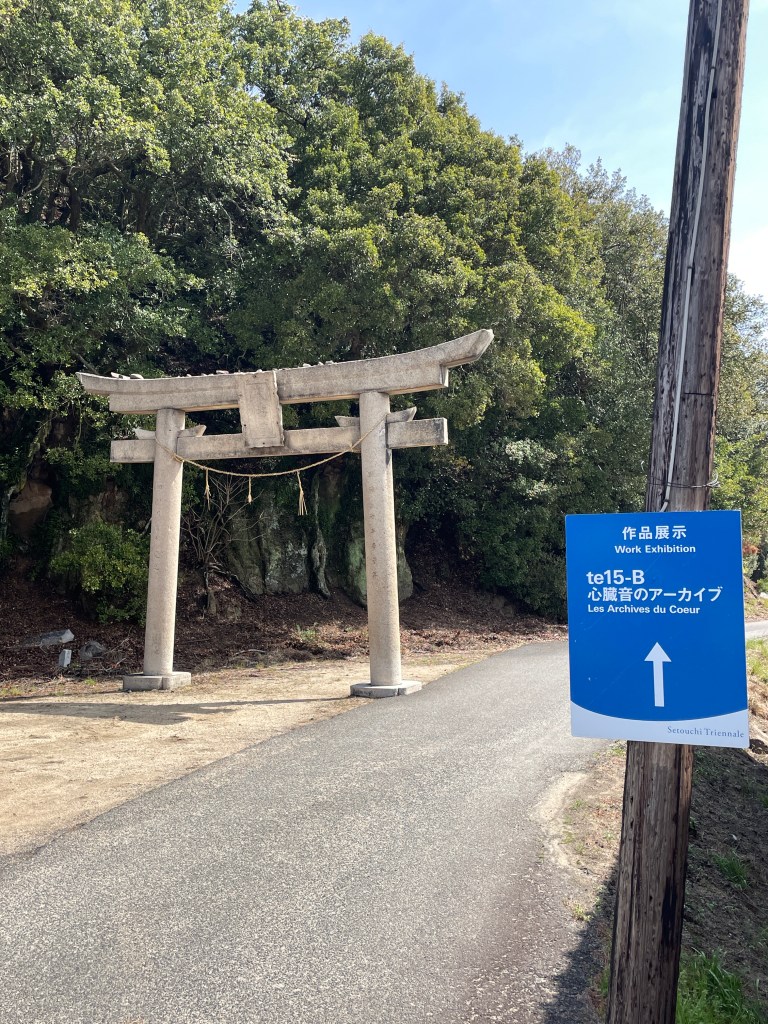
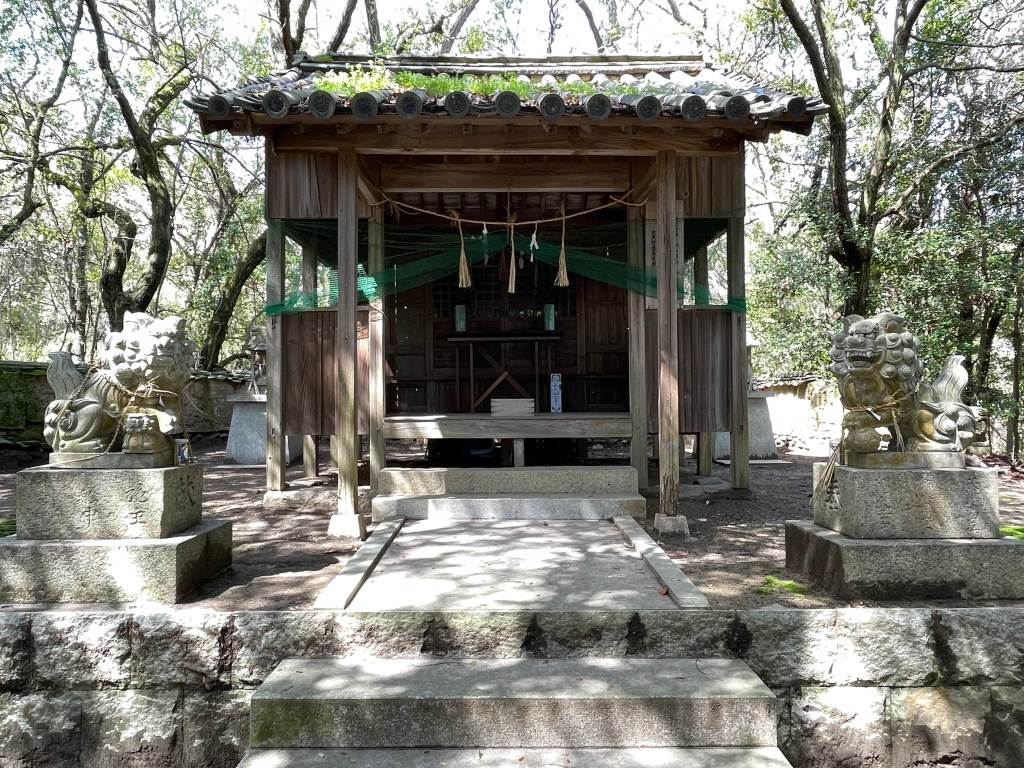
            There is art on Teshima too, and what I wanted to see was by Christian Boltanski, his Archives du Coeur and Forêt des Murmures. I also hoped to see a Shintō temple in the countryside, a sight someone had told me was not to be missed. Transport was a bit tricky on Teshima; the bus was so full that the driver rejected some of the passengers. I went to a little harbour at one end of the island and walked further, feeling as if I were alone in the world. It was an adventure, going from one small island to another one yet smaller, so very far from home. The sun shone, nature was all around me, there was nobody about, but there were signs to the Archives du Coeur, one of them beside a torii indicating a Shintō temple. It was part of the triennal Inland Sea art show, for which one must be grateful, but for romance an absence of signs would have been better.

            The temple was wonderful (on the way back there was an even more beautiful one), and eventually I came to the beach, which really did feel like the edge of the world, and was also where, in the words of Donald Richie, “I wanted to spend the rest of my life”. There, half hidden among the trees, was a little building where you could record your heartbeat and add it to many thousands of others. I didn’t do that; I had come to write Rudy’s name on a sheet of paper which would be transferred onto a metal label and be hung up with others on a tree in the Forêt des Murmures, to be blown about by the winds of the Inland Sea, and rained upon, and for ever be part of this extraordinary and incomprehensible place, where everything is alive and everything has a soul.