Not long ago in a hotel in Italy I found myself acting out the scene in A Room with a View where Charlotte and Lucy are disappointed by their rooms in a pension in Florence: “She promised us south rooms with a view close together, instead of which here are north rooms, looking into a courtyard, and a long way apart. Oh, Lucy!” This is the text from the book; as far as I can remember it appears word for word in the film, with Maggie Smith as Charlotte and Helena Bonham Carter as her cousin Lucy. My own hotel room was on a low floor and looked onto a courtyard; peering through a fence one could see a wide expanse of concrete and a few trees. It was dark, and cold, and not what you expect from a hotel advertised as having views of Lake Garda. Tired after a long day, I complained, and was probably, like Charlotte and Lucy, “if the sad truth be owned – a little peevish.” But, as Lucy says, “I wanted so to see the Arno…”
And then a miracle happened, although mine was less dramatic than in the book, where Mr Emerson, “one of the ill-bred people whom one does meet abroad”, joins in their conversation – “I have a view”- and offers to exchange their rooms for his and his son’s. With me it was a couple who offered to change their room – with view (“if you lie on your left side you can see the lake from the bed”) – for mine, without. Charlotte and Lucy are embarassed by this proposal from an ill-bred man to whom they have not been introduced; as for me I can still hardly believe that anyone wanted my horrid room, and later had to prevent myself from asking them if they hadn’t found it too cold, but at least there was no embarassment involved in accepting. For the rest of the trip I thought of them as Mr and Mrs Emerson, however unlike the fictional character they were, let alone the original one.
Later we visited the house of the poet Gabriele d’Annunzio, the Vittoriale degli Italiani in Gardone Riviera, which not only has views of the lake, but also a small aeroplane hanging from the ceiling of the auditorium, and half a battleship in the garden. And a mausoleum and an amphitheatre. One can wander around the
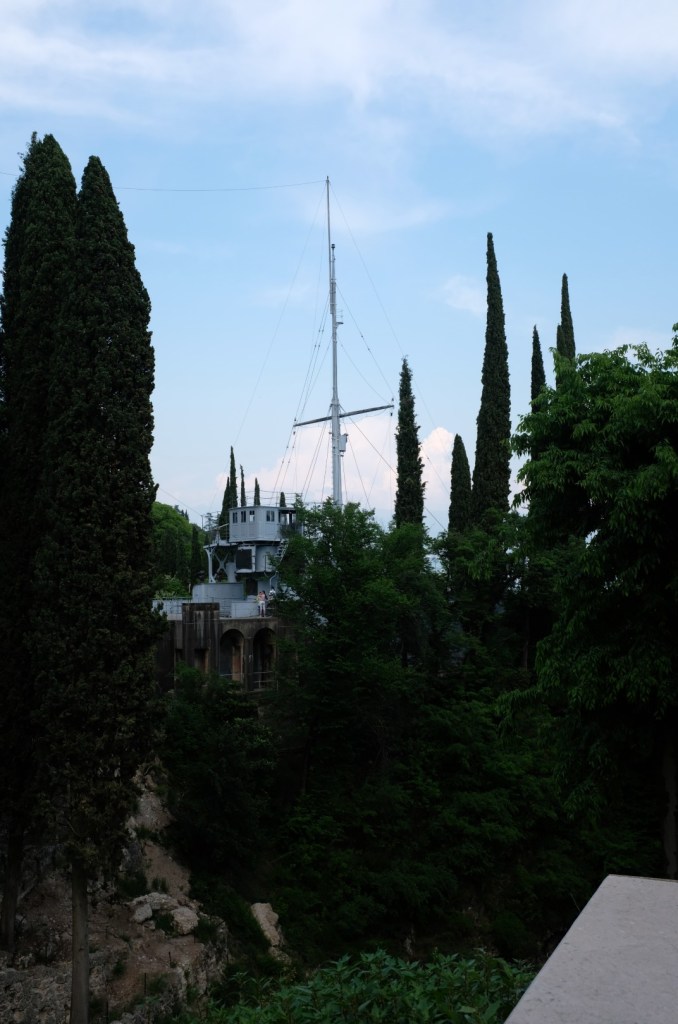
garden and look for the battleship (surprisingly easy to miss), but visitors to the house were only allowed to enter in groups of ten at a time. In her biography of d’Annunzio, The Pike: Gabriele d’Annunzio, Poet, Seducer and Preacher of War, Lucy Hughes-Hallett describes the house as “a bizarre piece of installation art”; it was certainly one of the strangest houses I have ever visited.
D’Annunzio was a very small man, with bad eyesight; imagining yourself in his shoes you might feel more at home than we galumphing tourists did. The house is exactly as he left it: musty and airless, and you are not allowed to take photos; there are some online but they make it look much brighter and not nearly as strange as it actually is. The first impression is almost as if one were underground, with narrow passages leading into musty rooms, in semi-darkness and so full of objects that you almost panic in an attempt to see it all: there is Dante, and Shakespeare, then Venus, a statue, veiled, of his great love Eleonora Duse, a stuffed turtle, thousands of books, weapons, mysterious texts on the walls, and objects everywhere, things things things, more than you have ever seen together. Hughes-Hallett describes some of the effect: “Everything in the Vittoriale is placed on something else. A rosary is draped over a statuette which stands on a piece of embroidered velvet, which covers a majolica box which is set upon a carved table which stands on an oriental rug. Every window is filled with stained glass and curtained with heavy, rich fabric; every available wall or ceiling space is encrusted with plaques and painted mottoes (…) And in among all the artsy clutter there are modern relics – the steering wheel of a speedboat, a paintbox, a rusty nail.” There is also the kitchen, a completely normal space with no decoration or unnecessary objects; d’Annunzio wasn’t interested in cooking.
Hughes-Hallett describes how there were two painters “busy transforming d’Annunzio’s rickety old house into a sacred space – part Franciscan, part Buddhist, part nineteenth-century decadent, entirely solipsistic.” And indeed you realise, as you try to shrink yourself to fit and see it all, that it isn’t just that everything is placed on something else, but also that everything refers to something else, to something personal to d’Annunzio; it is all connections and allusions, as if you were actually inside his brain. Some visitors found it so disturbing they didn’t even bother with the battleship and raced for the exit. These shadowy rooms filled with metaphors could not be further from the pure light of day as seen through Lucy’s window in Florence, or even mine from the left side of the bed beside Lake Garda, and it is just as well that one is shepherded briskly through them; d’Annunzio was a very good poet but you would not want to spend too much time in his mind.
 Mixed Feelings
such a wonderful summing up in your last sentence, thank you Sarah🍀
Ah, memories of Hotel Sirmione Terme! Nobody offered to exchange rooms but there was no need.
Lieve Sarah,Je nieuwe MF riep veel herinneringen op, vooral aan d