Some time ago I started following the diary of Samuel Pepys online, getting an email every day with the previous day’s entry. My brother used to get it, and I started doing it too when I inherited his phone after he died. The emails come from the website pepysdiary.com, which started in January 2002, and is now on its third reading of the diary: here is yesterday’s, Saturday, 16th August 1662. ‘Up by 4 a‑clock. And up looking over my work, what they did yesterday; and am pretty well pleased, but I find it will be long before they have done, though the house is cover‑d and I free from the weather.’ The roof had been taken off Pepys’s house a few weeks earlier and of course it rained: ‘I rose and went to my house and find that it is wet as the open street […] removed all my books to the office […] it raining all day long as hard within doors as without.’ (Sat 20 July 1662)
I am not sure exactly why these details should be so fascinating, but the diary is compulsive reading, and not just because of home improvements. It is as if you are in direct contact with someone living in the 17th century. For ten years Pepys described everything, his health, his arguments with his wife, his work at the Navy Office, his money, his involvements with women, gossip from Court and historical events. He was on the ship that brought Charles II from Holland in 1660, and at the Coronation in 1661, ‘although which to my great grief I and most in the Abbey could not see.’ But his most famous description is that of the Great Fire of London in 1666, which raged for several days very near his house and office.
In London recently I went to the City to look for Seething Lane, where he lived and worked. There are few things more enjoyable than following a trail in a strange city, and this part of London was quite strange to me. As a child I was taken to see the Crown Jewels in the Tower of London, but that was all; I didn’t even know that the Monument, familiar only as the name of a tube station, is a commemoration of the Great Fire. Pepys would have known it, perhaps even gone up it, as it was built in 1677. It is closed now, maybe just as well, as it has 311 steps; in the past you got a certificate if you reached the top. Nearby is a plaque marking the spot where the fire started, in a baker’s shop, and some stone blocks with the words of the nursery rhyme ‘London’s burning’ (‘Fire, fire/ Pour on water, pour on water’).
Many churches burned down, the first was St Magnus the Martyr: ‘it began this morning in Pudding Lane, and that it hath burned down St Magnes Church,’ (Diary, 2 September 1666) The churches that survived, many restored by Sir Christopher Wren, are now squashed between huge modern buildings with nicknames like the Cheesegrater and the Walkie-talkie (the hugest and ugliest of them all), their towers elegant amid the glass and metal; it is a miracle that any of them survived.

St Magnus the Martyr
Literally a miracle: in 1920 a commission proposed knocking 19 of them down, and T.S. Eliot wrote that they gave ‘to the business quarter of London a beauty which its hideous banks and commercial houses have not quite defaced.’ St Magnus even appears in ‘The Waste Land’: ‘the walls of Magnus Martyr hold/ Inexplicable splendour of Ionian white and gold,’ but I cannot attest to that as it was, sadly, as firmly closed as the Monument.
The site of the Navy Office in Seething Lane is now a garden,
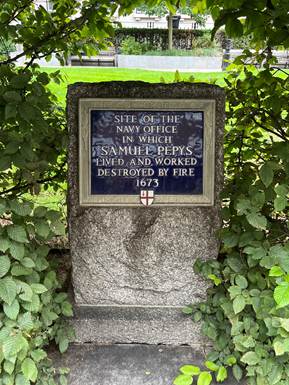
with a bust of Pepys when young and, if you look carefully, set in the pavement, a few stones with carvings referring to the Diary. One is a page from it, in Pepys’s shorthand, and another, thrillingly, represents his ‘Parmazan cheese’, saved from the flames: ‘And in the evening Sir W. Pen and I did dig another [pit], and put our wine in it; and I my Parmazan cheese, as well as my wine and some other things.’ (Diary, 4 September 1666) Parmazan! No ordinary cheese. He dug it up again on 14 September.

Walking around in this area was like following a map made by ghosts: the buildings have almost all gone but the streets are still there, with their original names as they appear in the Diary. That is all except one, Pepys Street, which comes off Seething Lane, opposite the entrance to the churchyard of St Olave’s, Hart Street, where Pepys worshipped, and where he and his wife are buried. This church, originally built in the 13th century, was badly damaged during the War; in 1666 it was saved from the fire by Pepys and Sir W. Pen, who had houses around it destroyed to make a break to stop the fire. As the author of the ‘Pepys Walk’ writes, ‘You are nearer to Samuel and Elizabeth in this church than anywhere else in London.’ The clerks of the Navy Office asked for their own pew in the church (Diary, 19 August 1660) and eventually one was allotted to them in a new gallery. Now there is a plaque on the outside wall of the church, ‘Entrance to the South Gallery and the Navy Office pew often mentioned in the Diary of Samuel Pepys’.
I have never lived in London, but when I was a child we lived in Richmond and I went to school in Hammersmith. Whenever I go back I get a jolt from the names of the stations on the District Line; these were the ones on the way to school – Gunnersbury, Turnham Green, Stamford Brook, Ravenscourt Park – mysterious places where one never got out. The City was the same: familiar names, like Pudding Lane, but I had never been there. And now there I was, on Eastcheap, Lower Thames Street, Hart Street (of course) and Pudding Lane itself, and it was a little like walking around in Rome and trying to see the past through the present, but here it was muddled up with my own life as well: strangeness and familiarity all at once, and layers of the past, as difficult to read and as easy to miss as those plaques in the paving stones of Seething Lane.
But it is not yet the past: it is still only August 1662 in the Diary, so there are another four years to go before the Great Fire. An awful lot is going to happen in Seething Lane before that Parmazan is made and shipped to London.
 Mixed Feelings
I do love your blog! And love that it’s linked to instagram so I remember to read it!
Helemaal geen gemengde gevoelens: onverdund plezier!
Wat een heerlijke zoektocht, wat een fijne kaas.
liefs,
Willem