Richard Linklater’s film Nouvelle vague is a kind of remake of A bout de souffle (1960) by Jean-Luc Godard, showing all the hidden parts: how it was financed, how Godard put the cameraman into a wheelchair, crammed the whole crew into a tiny chambre de bonne, and filmed without sound, so that Belmondo, as he ran mortally injured along the street, could reassure bystanders, “C’est pour un film!” Of course it wasn’t really a remake, but more like a Making Of, those little films one used to get on DVDs, which only looked as if they gave away secrets. Still, it sent me and surely many other people back to the original film, which was then brought out again in the cinema. Watching the real film with the memory of the fake or replica version in one’s mind was an odd experience: like remembering something that hadn’t happened – or had it?
I went to Paris and saw an exhibition that was doing something similar, showing the preparatory sketches for the frescos in the ceiling of the gallery in the Palazzo Farnese in Rome (finished in 1604). These were made by the brothers Annibale and Agostino Carracci from Bologna, in fact mostly by Annibale, for whom one soon develops something of a soft spot, partly because of a sketch of a man leaning on his elbows in a gallery, alone and in despair; apparently this commission finished him off entirely (he was even cheated on the payment). The paintings are wonderful of course, but the sketches are too, perhaps even more so. The Palazzo Farnese is the French Embassy, so getting in requires a passport check and a guided tour, and when you get to the gallery and look up – head back, crick in the neck, painting upside down – it is impossible to take it in. What you do see is the fantastic vitality of it all, the wit and cleverness, the bodies cavorting in space, most of all the impression that the artists who did this were enjoying themselves.
So seeing how they went about it, reading about their discovery of Rome, seeing a drawing by Agostino of the Ponte Sisto which they crossed to go to the Villa Farnesina, with its ceiling designed by Raphael, to a sketch of their plan for the ceiling, and more sketches of various arms and legs and torsos, all traced back to the actual paintings, is fascinating. Classical statues, like the huge Farnese Hercules, now in Naples, but then standing conveniently downstairs in the Palazzo, and the Belvedere Torso, now in the Vatican, are echoed in the muscly figures of the larger gods; not only are the paintings filled with allusions, but they also influenced later artists.
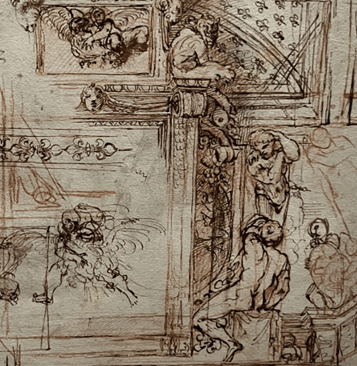
In fact the ceiling was so admired that Louis XIV wanted one too, and in 1667 sent artists to Rome to copy it. He had a replica of the Farnese gallery made in the Tuileries palace, and the full-size copies still exist, have been restored, and are also on show in the Louvre, together with a painting of how the copied version looked in the Galerie de Ambassadeurs at the Tuileries (which was destroyed in the fire of 1871). Today one can make beautiful copies of the ceiling with photos, and they have done that at the exhibition, indicating which parts exist in the form of sketches, but in the seventeenth century you had to send five artists to make huge drawings. And there they are in front of you, shadowy versions of the original.
At the end of the exhibition, your head still spinning with the idea of all these different versions and the beauty of the sketches, there is one more huge cartoon, looking like another copy. But it is actually one of the original drawings by the Carraccis, marked out in squares, which was used as the basis for a section of the painting. All this is tremendous material for a Rome fanatic like myself. I have shuffled through the Palazzo Farnese several times, waiting for the exciting moment of entering the Gallery, and been overwhelmed each time.
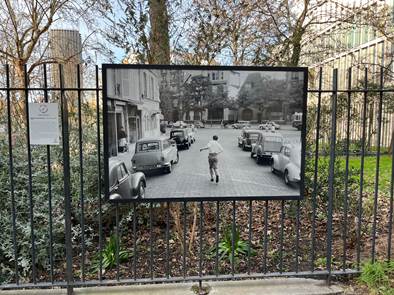
This time in Paris I stayed in a hotel near the spot where Belmondo fell dying to the ground; there is even a photo of the scene on a fence at the end of the street. It also happens to be the area where I worked for many years. The street, the rue Campagne-Première, runs between two boulevards, with nothing much special about it, apart from the fantastic building of artists’ studios and the view of the Cimetière de Montparnasse at the end; Linklater’s film doesn’t explain why Godard chose it, but perhaps it was because of the cemetery. I used to take the 68 bus every day from our distant 9th arrondissment, crossing the Seine near the Louvre, and getting out at the boulevard du Montparnasse. Now I went back to look at the bookshop where I worked, which has turned into a pottery studio, and the café where we sometimes had lunch (the best saucisses frites) and the post office, where I spent many hours queuing to buy stamps and send parcels. It closed at the end of last year.
Going back to Paris after living there for so long has sometimes been painful; once I actually cut a visit short and raced home early. This time I walked familiar streets, remembering several older versions of myself, then took the 68 to the Louvre to go to the exhibition, and did it all not just painlessly but even light-heartedly: “C’est pour un film!”
 Mixed Feelings