It was like a dream, crossing a bridge, going through an archway and finding myself in a completely empty Renaissance town. There were houses, and streets, and the streets had names, but there were no people. There were hardly any trees either, and it was very hot. The archway through which I had entered was called the Imperial Gate; at the opposite end of the town was the Victory Gate, and between the two were zigzagging walls, with wedge-shaped bastions on the six corners. This was a fortified town, one man’s dream, the town of Sabbioneta, built as the ideal Renaissance city by Vespasiano Gonzaga Colonna (1531-1591), a member of a cadet branch of the Gonzagas of Mantua.
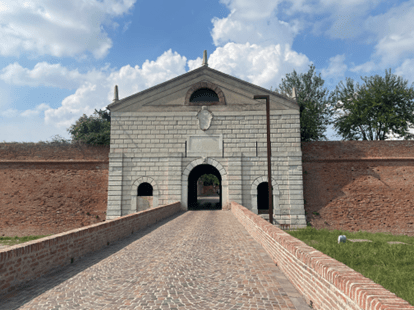
The road from Mantua goes past Sabbioneta, so all you see of it from the outside are brick walls and the Imperial Gate; it looks extremely private. Were there signs saying “Welcome to Sabbioneta, Unesco World Heritage site”? I didn’t see them. Disoriented, just glimpsing a Poste Italiane van whisking off like the White Rabbit in Alice in Wonderland, I got myself to the deserted main street, the Via Vespasiano Gonzaga, and found the first amazing building in this tiny town, the 96 metre long Gallery. It was empty, like everywhere else, and the view of it from ground level gives no idea of the glory above, on its first floor. It stops at the road, seeming to go nowhere, but the other end leads to the Garden Palace. Even in this small town the duke had not only a ducal palace, on the main square, but also a garden palace, with smaller rooms, ornately frescoed, from one of which you step, quite unexpectedly, into the first floor of the gallery. This is all painted wood, with trompe-l’oeil paintings at each end, with columns and garlands and cherubs and views of imaginary cityscapes. The city end stops short, with a door leading into thin air. The gallery is empty now, having originally housed the duke’s collection of antiques. Here there was another visitor, a smartly dressed old man who said, as we met in the middle of this deserted splendour, “Incredible, in such a small place.” He would have taken his hat off, had he been wearing one.
I saw him again, from time to time, turning a corner; it would not be easy to avoid people in Sabbioneta. The empty streets, classical buildings and the heat made it feel like a painting by de Chirico, and there were surrealist touches too, the room in the ducal palace with a frieze of elephants, and the wooden equestrian statues of Gonzagas, one of Vespasiano himself, dating from 1589. Four lifesize riders in armour, on wooden horses, quite startling at first sight. Two people were sitting outside a café as I passed, but by the time I came back they had vanished and the café closed.
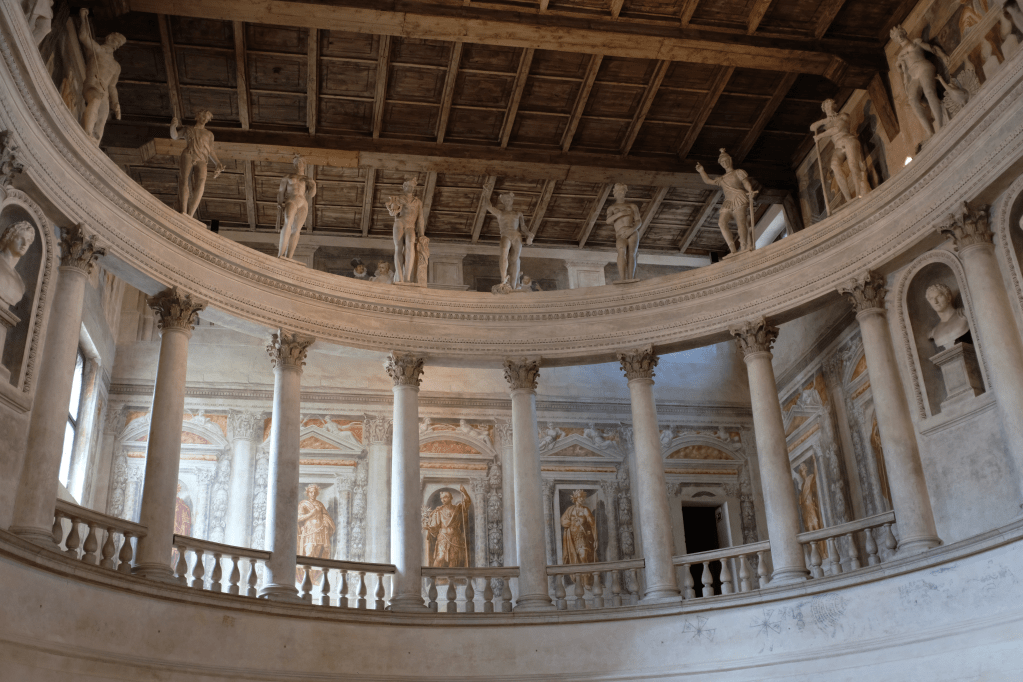
The most wonderful sight in Sabbioneta is the theatre, built between 1588 and 1590 by Vincenzo Scamozzi, the first Italian theatre built as such rather than an existing building. Here too you step straight from the street into the Renaissance; there is a semi-circle of columns with gods from Olympus above them, and painted musicians and spectators on the walls. Much has changed, the roof, the stage, but these remain, they have been standing there for nearly 450 years.
From inside the walls of Sabbioneta you cannot see out and the streets are straight and narrow and empty, just like Renaissance paintings of ideal cities. Squinting down one very long arcade I thought I saw a few people sitting outside on plastic chairs, but otherwise the town seems to be as Vespasiano left it, in decline since his death in 1591. I got there from Mantua on a bus full of schoolchildren, all on their phones and unnaturally quiet, only one of whom got off at Sabbioneta. On the way back there was a man waiting at the bus stop, very friendly and talkative, full of complaints about the buses and recommendations about food: I was back in the real world. Then he said he was a pilgrim, and had just walked from Assisi. So maybe not.
 Mixed Feelings
Nice description of one of many Italian wonders, deserted towns, unknown to the mass tourism, so far.
I had the same feeling when I visited Italian cities e for the first time during the lunchtime back in the eighties. The streets were empty, and the old towers cast long shadows on piazzas, like in De Chirico paintings.
He white rabbit ……..
Verstuurd vanaf mijn iPhone
<
div dir=”ltr”>
<
blockquote type=”cite”>