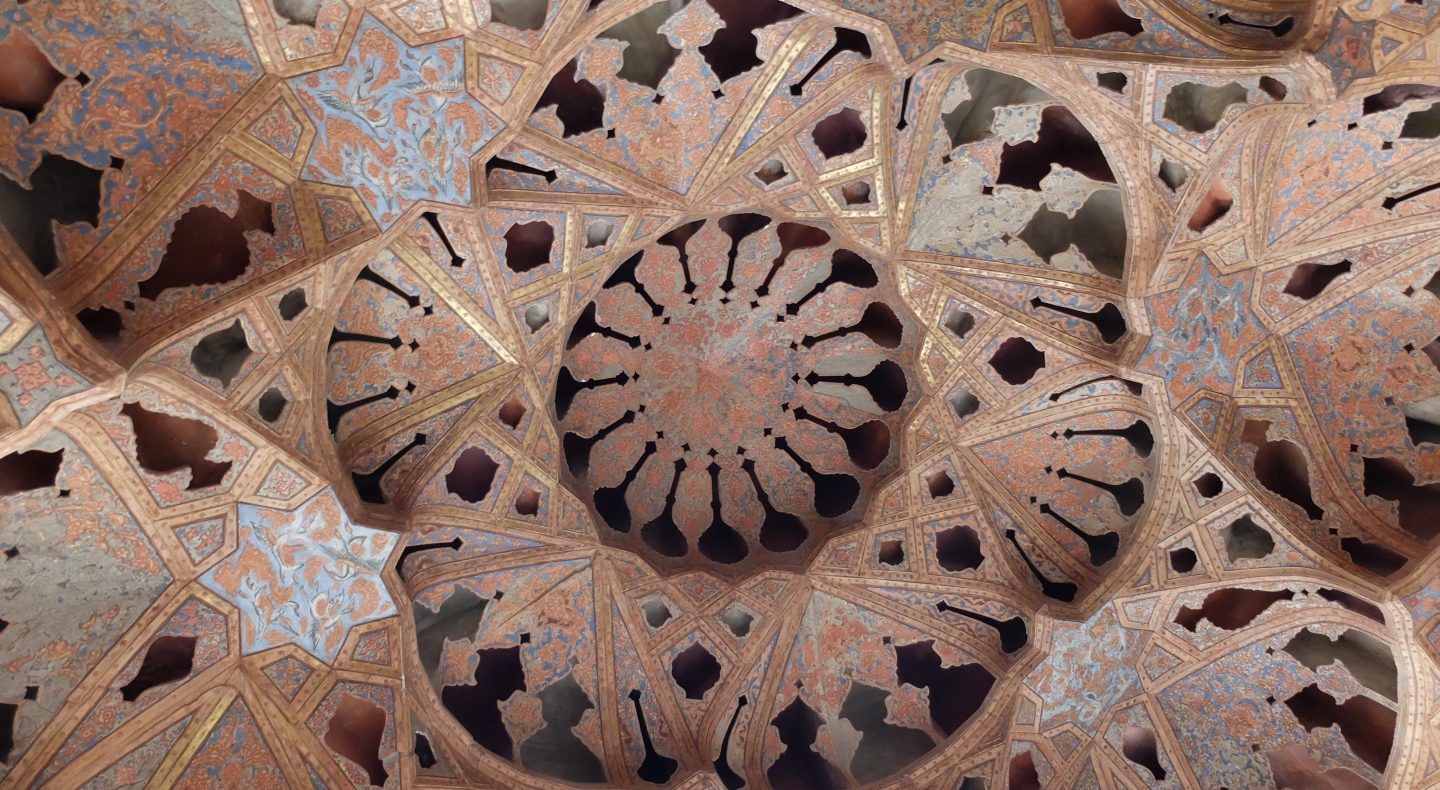
When I was in Trieste I went to a session of the Ulysses Reading Group – ‘Fridays at 5 p.m. Open to everyone, always!’ – at the public library. I saw the poster when visiting the writers’ museum, with its wonderful displays about Joyce, Italo Svevo and Umberto Saba, and sent a photo of it to my daughter, who is in a Ulysses reading group of two: ‘Go!’ she replied, so I did. The Trieste group, one of the members told me, had been going for two years and they had reached ‘Aeolus’, episode 7, very appropriately for such a windy city. The first thing you see in the Joyce part of the museum is a film with a pair of shutters, which open to show people being blown about by the bora, a fearsome Triestine wind, to the accompaniment of a snatch of text from Finnegans Wake: ‘the Boraborayellers, blohasting tegolhuts up to tetties and ruching sleets off the coppeehouses, playing ragnowrock rignewreck, with an irritant, penetrant, siphonopterous spuk. Graussssss! Opr! Grausssssss! Opr!’ (p. 416-7) Alas the bora wasn’t blowing when I was there, but this text went very well, even became partially comprehensible, with the old films of people bent over against the wind, the skirts of their coats flapping, hanging on to railings, or to each other, trying to push wheelbarrows or keeping their balance on bicycles.
In the films there were ropes along the streets to hold onto, and I saw one of these in the via del Monte. Trieste is full of plaques about writers, and this street had a line from a poem by Umberto Saba, about ‘un’ erta che si chiama via del Monte’. I looked up the word ‘erta’; it means ‘uphill street’, and makes you feel how poor a language English is, despite Joyce, that it has no single word for an uphill street. This particular erta was almost vertical, it had steps and ropes attached to the houses, and I made my way gingerly downhill, clinging on like the ghostly people in the old films.
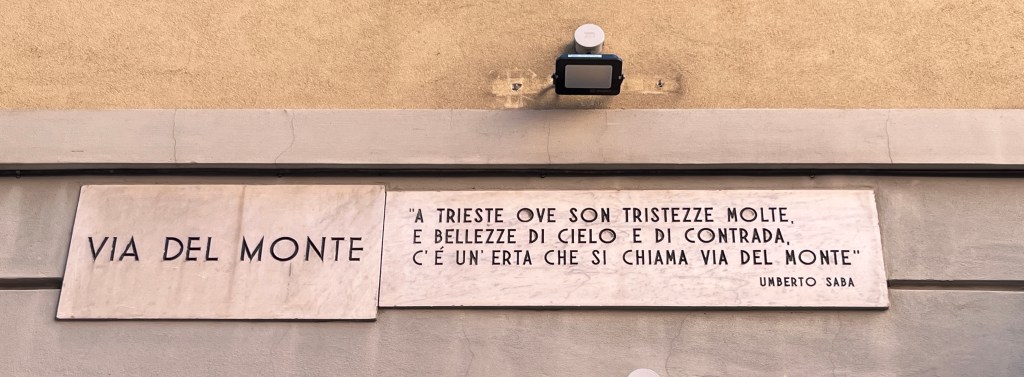
I passed another street with a quote from Saba, from the same poem, ‘Three streets’: the via del Lazzaretto Vecchio, which inspires in him a mood of quiet melancholy: ‘Amid old identical buildings like hospices,/ there’s one note, only one, of cheerfulness:/ the sea at the end of its side-alleyways.’ (Translation by Patrick Worsnip) It is true that the view of the sea at the end of a street has a positive effect on one’s spirits. Saba often wrote about his love for Trieste, and Svevo’s books are set there; I had wanted to go there for many years, because of Joyce, and I suppose I was expecting some kind of epiphany in this almost mythical place. But it seems that I had waited too long. I wandered around, finding myself again and again at the waterfront (it was blocked off most of the time I was there because of the yachting show, after that by the marathon), and tried to conjure up an atmosphere which seemed to vanish around the corner before I could catch it. Rudy too dreamed of going there, I wished I hadn’t had to do it alone.
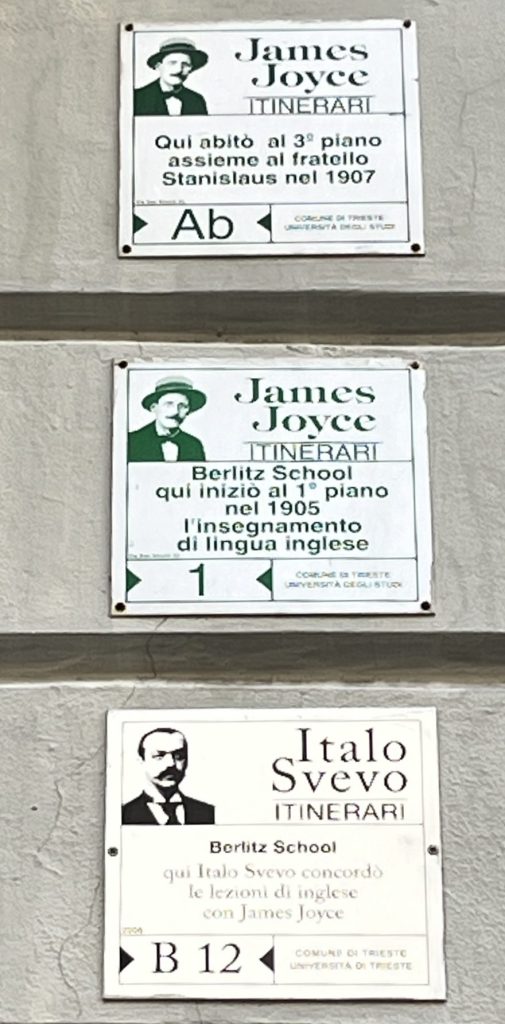
Most of the plaques in Trieste are about Joyce, and they are not quotations (which would have to be in English; alas for the city whose most famous writer was a foreigner) but indications of the houses he lived in, the cafés, or coppeehouses, where he drank, even one of the brothels he frequented. There are plaques for Svevo too, and once in a while they intersect, as in the building where the Berlitz School was, where Joyce gave Svevo English lessons. In a kind of literary historical overdrive, this is next door to Saba’s secondhand bookshop, the Libreria antiquaria Umberto Saba, the only thing, apart from the streets, that still exists. And is still functioning; I bought a little pamphlet there about the only first edition of Ulysses bought by someone from Trieste, and later sold by Saba’s shop in 1954 for $100. This copy had a dedication by Joyce to Baron Ambrogio Ralli, whom he had met at the Greek Orthodox church of San Nicolò, and to whom he later gave English lessons. Joyce liked the Greek Orthodox church because of the music and the mysterious rites, also because of the rich members of the congregation who might want to learn English. I went there too, with a small frisson, because of actually being inside a building Joyce had been in, rather than outside gazing at what might possibly have been one of his windows.
Following the Joyce trail from the tourist office’s leaflet eventually made me feel uneasy, as if I were chasing him, like one of his creditors. So many different flats, so much trouble with work and money and the drink; it hardly seems possible that he also did so much writing. And this had nothing to do with the writing; it was like reading only the writer’s biography and none of his work. In the end I gave up on the plaques and went to the cemetery, to pay my respects to Stanislaus Joyce, younger brother to a genius, who was sorely tried in many practical respects (money, lodging, drink). He stayed in Trieste, married and died there. As a good illustration of the general weirdness of Trieste, he, born a Catholic, is buried in the Cimitero evangelico, while Svevo, one of the models for Leopold Bloom, and Saba, both partly Jewish, are in the main, Catholic, section.
The reading group found me a copy of Ulysses, but what they were actually reading that week was a story from Dubliners. ‘A little cloud’ is about a man who has a drink with an old friend, Ignatius Gallaher, who is also a character in Ulysses, and who had moved – or got away – to London. I think Joyce wrote this in Trieste, basing Gallaher on a friend from Dublin. It is a strange and rather depressing story, but it was text, at last. I was reading Joyce in Trieste! The city may be, as Jan Morris writes, an imaginary city, a backwater left behind by history, a place of exile and tristesse, but it is also, thank goodness, a real place, with a real university and real people who read Joyce every Friday at 5 pm. Graussssss! Opr!

